
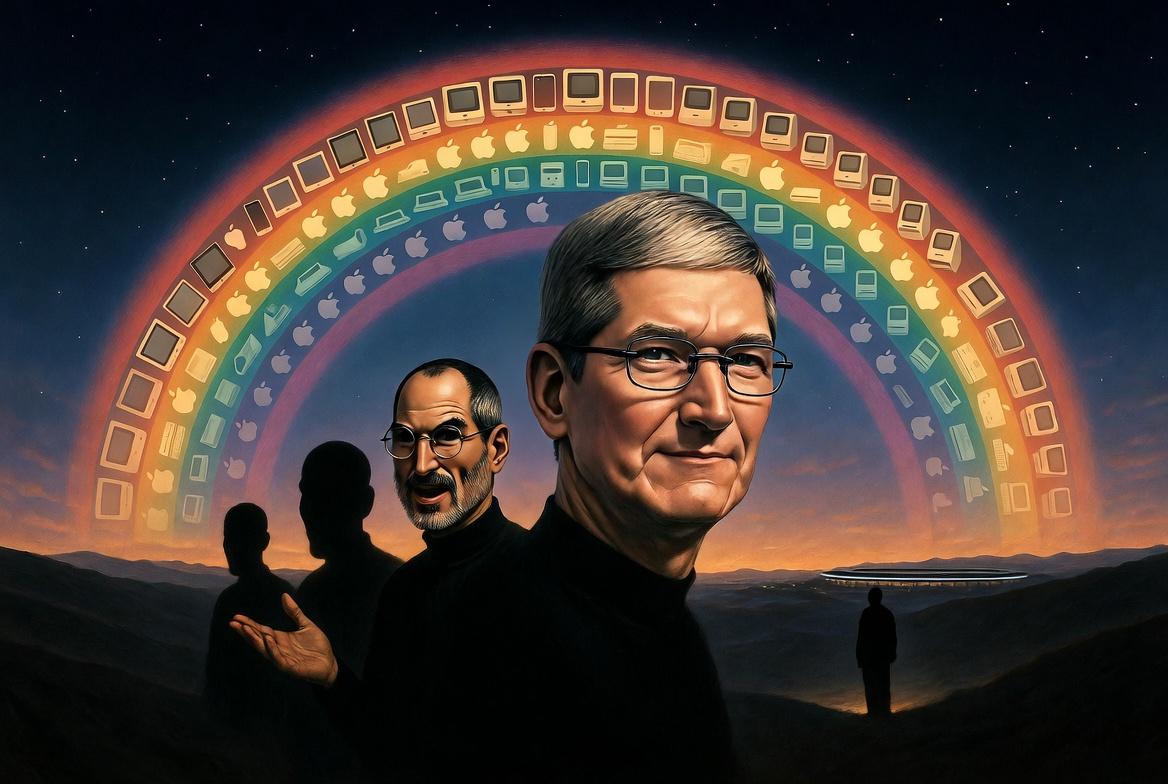
The next decade of Apple will be harder than the last one. Cook's legacy is real. So is the problem it leaves behind. Cook mastered the industrial side of technology: supply chains, global logistics, vertical integration, and the art of turning a product launch into a semi-religious event. He transformed a boutique hardware company into a civilization-scale platform. What comes next requires mastering something fundamentally different: intelligence.
There's a particular kind of silence that only Apple can produce: controlled, purposeful, slightly maddening. In November 2025, a 330-word article in the Financial Times, co-bylined by four reporters (an editorial choice that is never accidental) broke that silence. Apple's board and senior executives had "recently intensified preparations for Cook to hand over the reins." John Ternus, SVP of Hardware Engineering, was named as the leading candidate to succeed him. Four bylines on 330 words. In journalism, four bylines on 330 words is choreography.
Bloomberg's Mark Gurman pushed back within days, calling the timeline "premature" and saying he would be "shocked" if Cook stepped down as outlined. By January 2026, Gurman had quietly revised his position. The departure wasn't imminent, but the machinery of succession was unmistakably in motion. Cook had already handed oversight of Apple's design teams to Ternus. The signal was, as Gurman put it, "crystal clear."
The Mountain in Front of the Next CEO
The central strategic challenge facing Apple's next chief executive is not finding the successor to the iPhone. It's something more immediate and more dangerous: the company that perfected hardware may be losing the software war that defines this decade.
When ChatGPT launched in late 2022 and the generative AI arms race ignited, Apple's response was notably restrained. Siri, the voice assistant that had dazzled audiences at its 2011 debut, had quietly become a punchline: the assistant that could not answer a follow-up question, couldn't handle ambiguity, couldn't compete with what OpenAI, Google, and Microsoft were shipping weekly. Internal meetings reportedly had Apple executives describing the Siri delays in terms they rarely used in public: one executive called the situation "ugly."
Apple delayed a major Siri overhaul, one that was supposed to bring it into conversational parity with ChatGPT and Gemini, by at least a year. Features originally targeted for 2024 slipped to 2025, then to 2026. The redesigned Siri, codenamed internally as a two-phase rebuild, now aims for "personal context plus cross-app execution" by iOS 26.4 in spring 2026, with the more ambitious chatbot-like transformation to follow.
The external pressure is mounting in parallel. In January 2026, investor Ross Gerber of Gerber Kawasaki publicly called for Cook's resignation, arguing Apple had "completely missed the AI boat" and "needs Google to survive." Activist investors have been wrong about Apple before. But Gerber's frustration echoes a sentiment spreading across Wall Street: the most valuable company in the world is playing catch-up in the technology that will define the next decade.
Cook's public response to the AI question has been characteristically precise. During Apple's fiscal Q1 2026 earnings call, he framed privacy not as a constraint but as a competitive weapon: "We are integrating it across the operating system in a personal and private way. We see both being important, the on-device and the private cloud compute. We do not see it as an either-or."
The strategic bet is coherent: in an era of growing privacy anxiety and regulatory pressure on data collection, Apple's on-device AI architecture is genuinely differentiated. If Siri 2.0 delivers, Cook will have validated a methodical, privacy-first approach to AI. If it disappoints again, the questions about whether a supply chain genius can lead a $4 trillion company through the intelligence era will intensify significantly.
That pressure, which will likely resolve before any succession announcement, is the first thing the next CEO inherits.
From Robertsdale to Cupertino: The Operator's Origin
Timothy Donald Cook grew up in Robertsdale, Alabama. That matters only because it explains the instinct toward operational discipline that would define his career. He earned a degree in industrial engineering from Auburn University in 1982, an MBA from Duke in 1988, and spent twelve years at IBM before Compaq, before a phone call that changed everything.
In 1998, Steve Jobs hired Cook as Senior Vice President for Worldwide Operations. Apple was teetering. Jobs had returned the previous year, but the supply chain was a disaster: too many products, too much inventory, no discipline. Cook's solution was radical: he characterized inventory as "fundamentally evil" and compared Apple to a dairy, in that products should be sold while they were fresh. He reduced Apple's inventory turnover from months to days. The precision was surgical. When HP later described their cancelled TouchPad tablet, they said it was made from "cast-off, reject iPad parts," meaning Apple had already bought up every quality component on the market.
Cook's ascent to CEO in August 2011 was greeted with widespread skepticism. Ben Wood, analyst at CCS Insight, captured the consensus at the time: "Many people said there was 'no chance, this supply chain guy hasn't got the charisma.' It was seen as a safe, but rather conservative bet."
Then he proceeded to build the most profitable corporate machine in human history.
Under Cook, Apple became the first company to reach $1 trillion in market capitalization (2018), then $2 trillion (2020), then $3 trillion (2022), briefly touching $4 trillion in 2025. The Services division, barely $9 billion when Cook took over, grew to over $100 billion annually at margins that hardware companies cannot touch. The Apple Watch and AirPods, product categories that didn't exist before Cook, became multi-billion-dollar businesses on their own.
Cook turned Apple from a boutique hardware company into an inescapable global infrastructure. The question is whether that infrastructure can learn a new discipline.
Steve Jobs gave Cook an unusual parting gift when handing over the company. According to Cook, Jobs called him to his house and offered him the role with one specific piece of advice: "I'll never forget that and it was such a gift for me, because he took off of my shoulder this question of, 'What would Steve do?' I just put my head down and thought, 'I'm going to be the best version of myself.'"
He was. The scoreboard for the Cook era is already written: $350 billion to $4 trillion, a billion active iPhones, a Services business larger than Boeing, and a supply chain so precisely calibrated that Apple's inventory turns over roughly once every five days. On operations, Cook has no peers.
When the Lieutenants Leave
Before the FT's November 2025 story landed, the signal was already being sent through departures. Apple's executive bench began to thin in ways that, taken individually, could be explained away. Collectively, they told a different story.
CFO Luca Maestri transitioned out in January 2025. COO Jeff Williams, once widely considered Cook's natural successor, announced his retirement in July and formally departed by year's end. AI chief John Giannandrea announced he was stepping down. Design SVP Alan Dye left for Meta. General counsel Kate Adams announced plans to retire. VP of environment and policy Lisa Jackson followed. Apple's senior leadership page, famously stable for years at a time, began to look like a departures board.
The executive shuffle is partly generational correction. A company that kept its leadership unusually static finally experiencing natural attrition. But as Fortune noted in its December 2025 analysis, the departures span "functions critical to Apple's competitive position." And beyond the headline names, Apple has also been quietly losing AI research talent to OpenAI, Google, and Anthropic.
Cook's response to the AI talent question was to bring in Amar Subramanya, a former Microsoft AI executive, to lead Apple's foundational AI models, a rare external hire at the senior level for a company famous for promoting from within. The reorganization placed Subramanya reporting to Craig Federighi, with Eddy Cue absorbing broader AI strategy responsibility. The result looked less like a clear structure than a triage.
The Throne Room
In a November 2023 podcast appearance with pop star Dua Lipa, Cook delivered the most candid public accounting of his succession thinking Apple fans had ever heard. He acknowledged not knowing how long he'd remain: "I love it there. I can't envision my life without being there, and so I'll be there for a while." He confirmed succession plans existed: "We have very detailed succession plans. Because something unpredictable can always happen. I could step off the wrong curb tomorrow." And he declared a clear preference for the next CEO: "I really want the person to come from within Apple, so that's my role: that there's several for the board to pick from."
Several. Not one. A menu of internal candidates, shaped and prepared, presented to the board. The selection, when it comes, will be made by committee. That itself is a statement about what Apple has become.
Then there is Sabih Khan, the name that keeps surfacing in betting markets. Khan runs Apple's operations, the same domain Cook used as his launchpad to CEO. Polymarket currently prices Khan at roughly 20%, second only to Ternus. The logic is straightforward: if Cook proved that an operations mind could run Apple, Khan is the closest structural parallel. He manages the supply chain that ships a quarter-billion iPhones per year across 175 countries. What he lacks in public profile he compensates in institutional leverage.
The case for Ternus is strongest on paper. He is Apple's youngest SVP at 50, possesses 24 years of institutional memory, and has been methodically prepared. His expanded remit now covering hardware engineering, design oversight, and increasing strategic input on product roadmaps. His perfectionism is legendary inside the company: as a young engineer, he spent weeks arguing with a supplier over the number of grooves in screwheads for the Apple Cinema Display. Twenty-five grooves, not thirty-five. "It might not be normal, but it's right," he later told a Penn engineering graduation class.
The concerns about Ternus are also real. Six former Apple employees, cited in a January 2026 New York Times profile, described him as better known for maintaining products than inventing them. Some inside Apple worry he lacks the geopolitical fluency that Cook deployed so skillfully with the Trump administration, and that his public charisma, perfectly adequate for product launches, may not be sufficient for the full CEO stage. Analyst Gene Munster has floated the possibility of a transitional co-CEO arrangement before Ternus takes the reins fully.
The Walled Garden Gets Lawyers
One of the less glamorous but defining challenges of the post-Cook era will be fought not in product labs but in courtrooms in Brussels and Washington. Apple is, as tech analyst Ben Thompson has long argued, an ecosystem operator masquerading as a device manufacturer. For fifteen years, it has dictated the terms of the mobile internet because it owned the glass through which we viewed it.
The European Union's Digital Markets Act is systematically dismantling that monopoly. Third-party app stores are now permitted on iOS in Europe. Payment systems are being forced open. Regulatory scrutiny of the App Store's 30% commission (which developers have called a digital toll road) is intensifying on both sides of the Atlantic. A U.S. antitrust trial looms.
The post-Cook CEO will spend as much time managing antitrust lawyers in Brussels and Washington as working with designers in Cupertino. Cook's particular gift for political navigation, what Dan Ives of Wedbush called being "10% politician, 90% CEO," may turn out to have been as important a qualification for the job as any product instinct. His successor will need the same skill, without Cook's accumulated relationships.
Apple's market capitalization reporting record $143.8 billion in Q4 2025 revenue (up 16% year-over-year) suggests the garden is still very much intact. But the walls are showing stress fractures, and the next CEO inherits both the fortress and the siege.
Mapping the Post-Cook Apple
As the succession question resolves, over months or years, three distinct futures present themselves. They are not equally likely, and they are not mutually exclusive. But they represent the range of outcomes that Apple's next chapter could deliver.
Apple leans fully into its status as the premium layer of the global internet. Like Hermès or LVMH, it commands staggering margins on hardware and software, with no apology for its prices. The iPhone becomes the digital Rolex. You do not strictly need it to stay connected, but you wear it for what it says about you. Services revenue grows steadily; innovation is evolutionary rather than revolutionary. Apple is enormously profitable, culturally dominant, and largely safe. The risk: it becomes the IBM of the 2030s: too profitable to collapse, too cautious to set the pace.
Apple succeeds at the hardware miniaturization and AI integration bet. The iPhone recedes into the background, replaced by an ecosystem of smart wearables (glasses, earbuds, watches) powered by a seamless, invisible Siri that anticipates rather than responds. On-device AI, running on Apple Silicon at the edge, becomes the privacy-first alternative to Google and Microsoft's cloud-dependent models. Apple is not just the most valuable company; it becomes the operating system of daily human life. This is the best-case scenario, and it requires executing on everything Siri has so far failed to deliver.
The nightmare. Regulators shatter the App Store economics, collapsing Services margins. Siri 2.0 disappoints. A credible Android AI alternative erodes Apple's premium positioning among younger buyers. Hardware becomes increasingly iterative as the next category, whatever follows the iPhone, fails to materialize under committee-led leadership. Apple does not collapse. It is too financially strong for that. But it becomes culturally irrelevant, servicing its installed base while genuine innovation happens elsewhere. The scenario is unlikely. It is also not impossible.
The Era of Statecraft
Tim Cook will leave behind a company that is less a technology firm than a civilization-scale institution. Apple holds the keys to the digital lives of roughly 2.2 billion people. Its market capitalization dwarfs the GDP of most developed nations. When Jobs left Apple, the question was whether the company could survive without him. When Cook leaves, the question will be more complicated: whether Apple has grown too large, too consequential, and too contested to be governed by a single person at all.
Apple has spent fifteen years perfecting the industrial side of technology: manufacturing, logistics, integration, global scale. The next decade will belong to intelligence. Whether Apple can retool for that discipline as thoroughly as it mastered supply chains and silicon will determine what the post-Cook era becomes. Cook built a supply chain that turns over inventory every five days. His successor needs to build an AI that answers questions just as well. That is the gap.
Cook has been at Apple for a quarter century. He will almost certainly leave as board chairman, his influence continuing through whoever sits in his chair. The supply chain mind that turned $350 billion into $4 trillion does not simply switch off. The question is whether Apple's next leader, Ternus, Federighi, or someone the world has not fully considered yet, can do for intelligence what Cook did for operations.
That is the only question that matters now. Tim Cook is, for the moment, still at his desk. The succession drama will resolve on its own timetable, in Apple's way, with Apple's silence until the moment it isn't silent anymore. But the strategic inflection is already underway. The post-Cook era has already begun. Cook just hasn't left yet.
Griffin de Luce is the founder and publisher of AppleToday. This piece synthesizes reporting from the Financial Times, Bloomberg's Power On, Fortune, CNN, MacRumors, 9to5Mac, and AppleInsider.